When I joined Coderina Education and Technology Foundation as a corps member, I thought social media management meant posting regularly, replying to comments and keeping an eye on the numbers.
Today I look after twelve accounts across four brands, on Facebook, Instagram, LinkedIn, X and TikTok. That includes Coderina itself and programmes like COUCH, the Coderina University Challenge, and eSTEAM, as well as our Innovations account. Somewhere along the way I learned that social media isn't posting. It's brand strategy, done in public, every single day.
These are the lessons that have stuck with me most.
Consistent doesn't mean identical
Every one of those accounts has to feel unmistakably like Coderina. But they don't speak to the same people.
COUCH speaks to university students, who want energy, competition and something they can be part of. eSTEAM speaks to learners and educators who want ideas they can use. Innovations speaks to people who are curious about how things are made. And the main Coderina accounts speak to everyone at once: parents, schools, partners, government and the wider public.
If all of those accounts sounded exactly the same, none of them would really sound like anything. So I think of them as one family with different personalities.
What stays the same across all of them:
- The mission: advancing STEAM and robotics education across Africa.
- The brand: the Coderina name, colours, logos and a recognisable look.
- The standard: accurate, clear and respectful of the people we feature.
What changes is the voice. COUCH can be playful and competitive. eSTEAM can be more reflective. Innovations can be more precise. The main accounts tie it all together. Getting that balance right is a big part of the job, and it's something I check every time I plan content.
Make technical work feel human
On our Innovations account, we share Coderina's work in additive manufacturing and reverse engineering, especially 3D printing. It's genuinely impressive work. It's also very easy to describe it in a way that loses almost everyone after the first sentence.
My approach is simple, and it works for most technical subjects:
- Start with what it does for a person. Not the machine, but the problem it solves.
- Show it. A short video of a print coming together says more than a paragraph of specifications.
- Then explain how it was made, for the people who want to know more.
The goal is to make technical work accessible and visually compelling without losing accuracy. I would rather a post be slightly less clever and properly understood than impressive and ignored. And if I can't explain something clearly, that's a sign I need to ask the team more questions before I post it.
Live events are a different sport
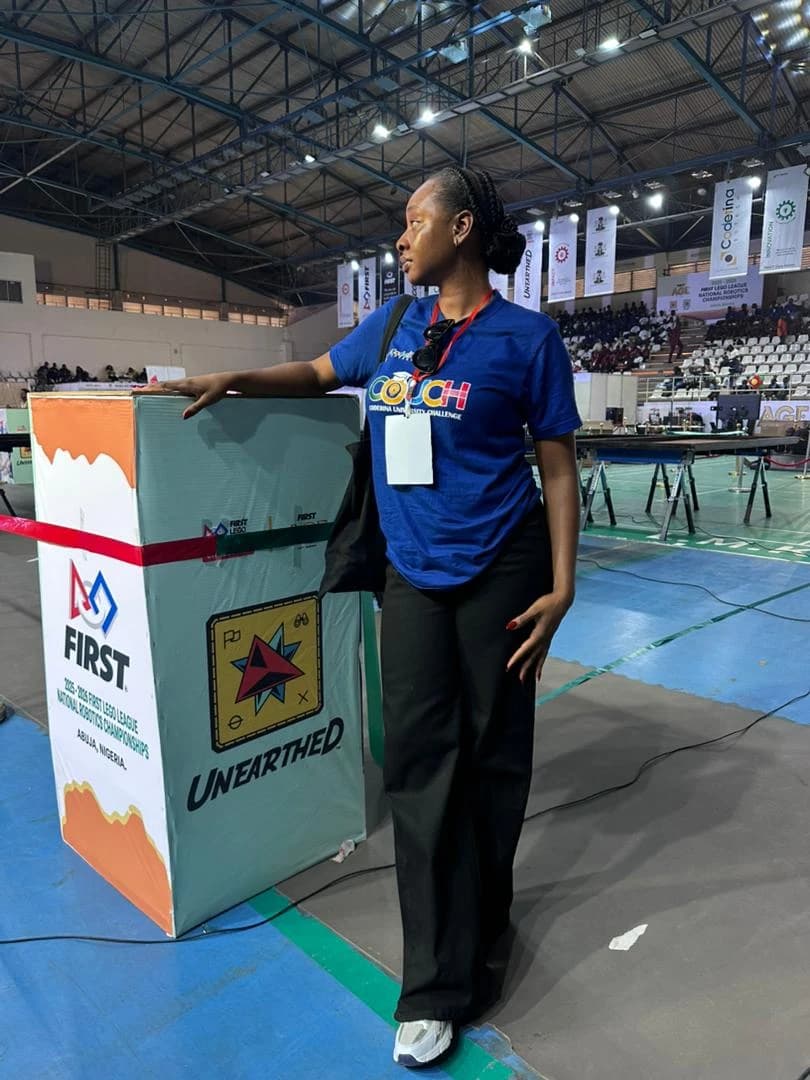
Nothing has taught me more than running the engagement campaign for the National Robotics Championship 2026. More than 500 students from federal unity colleges, state and private schools came together at the Moshood Abiola National Stadium in Abuja over three days, competing in the FIRST LEGO League Challenge and the FIRST Tech Challenge under the theme UNEARTHED.
Things move fast at an event like that. Matches end, teams celebrate, robots break and get fixed, and the moments that matter most don't wait for a content calendar.
What helped most was deciding the story before the event even started. We weren't going to announce results. We were going to tell a story about young Nigerians building, creating and solving problems. Once that was clear, decisions that could have taken minutes took seconds. Is this moment part of that story? Then it goes out.
We built the campaign in stages:
- Awareness, announcing the championship, its dates and the UNEARTHED theme with one consistent hashtag identity.
- Countdown, building anticipation so the championship felt like a moment, not a single post.
- Live storytelling, bringing the arena online as it happened, with photos and stories of students building, testing and competing.
- After the event, telling the stories of the teams heading to international championships.
The story didn't stay on our own channels. It was picked up by the Federal Ministry of Information and National Orientation and by independent Nigerian media. For me, that was the clearest proof that leading with people works. Journalists, like everyone else, are drawn to stories about people.
The practical lesson from live coverage is about preparation. Know your story, know your audiences, have your templates and hashtags ready, and agree in advance who approves what. Then, on the day, you can respond quickly without making careless mistakes.
Audience first, always
Before anything goes out on any account, I ask myself three questions:
- Who is this for?
- What do we want them to feel, know or do?
- Does it move our mission forward?
If I can't answer all three, it doesn't go out yet. That habit has saved me from plenty of posts that would have looked busy but said nothing.
It also helps when deciding what not to post. Not every update deserves a post on every account. Sometimes the most strategic choice is to share something in one place, for one audience, and do it well.
Growth is a side effect of usefulness
Under my management, the COUCH Instagram account has seen strong follower growth. People sometimes ask what the trick is. Honestly, there isn't one. Growth has come from showing up consistently, being genuinely useful or genuinely entertaining for the people we're trying to reach, and treating comments and messages as conversations rather than chores.
Social media isn't a noticeboard. It's a conversation you have to keep earning.
What I'm taking with me
I'm still learning every week. I take feedback, try new formats, and look closely at what lands and what doesn't. But I've come to love this work because, done well, it helps people see themselves in what an organisation does. A student sees someone like them building a robot. A parent sees what their child could become. A partner sees impact they want to be part of.
That, for me, is what communication is really about: not more noise, but helping the right people understand, trust and act.